Showing posts with label dog-health-and-care. Show all posts

Saturday, September 7, 2019

Why do dogs sneeze when they’re excited? The answer could be simple — or not. Plus, what about reverse sneezing or when dog sneezing gets serious?


You must remember this: A kiss is just a kiss, but a sneeze might be more than just a sneeze. So, why do dogs sneeze when they’re excited? There seem to be two schools of thought on the topic, adding a whiff of controversy to this common behavior.
Still, the fundamental things apply when asking, “Why do dogs sneeze when they’re excited?” Dogs have sensitive noses. And like humans, they sneeze if something irritates the inside of their nose, causing a tickle, then a sneeze from the chest and lungs to expel the offending intruder.

Why do dogs sneeze excited? They’re simply and truly just excited!

Why do dogs sneeze? They’re excited.

Why do dogs sneeze when they’re excited? When dogs are in an excited state, they often sneeze more shallowly, emitting a snorting sound caused by a sudden force of breath from the nose.
“These are not sneezes the way we think of a sneeze in people: a respiratory response from deep down,” says Debra Eldredge, DVM. “This is more like a child fooling around and pretending to sneeze.” Such sneezes are a form of canine communication, says the Vernon, New York, veterinarian and author. They happen frequently during play, when dogs naturally get excited. “This can be a ‘remember it is just play’ sound, something to cool things off if they are getting a bit heated. The sneeze communicates that the dogs are playing,” Dr. Eldredge says. “Turid Rugaas was one of the first people to really categorize dog interactions.”

Why do dogs sneeze when they’re excited? It calms them down.

Rugaas wrote the 2006 dog-training manual On Talking Terms with Dogs: Calming Signals. In it, the Norwegian author and dog trainer identifies 30 ways dogs communicate with each other — and with humans — through what she calls “calming signals.”
These signals, including sneezes, are a way of calming a situation before it gets too wild. The behaviors are the canine equivalent of social skills, a repertoire of body language and interaction used to communicate many things, including avoidance of conflict and an invitation to play. All dogs understand the code — even those who do not display the behaviors themselves, Rugaas says.

Why do dogs sneeze when they’re excited? They’re playing.

Why do dogs sneeze? They might be playing.

So, “Why do dogs sneeze when they’re excited?” has a simple answer, right? Bruce Fogle, DVM, isn’t buying the above reasoning. “It’s not a signal, calming or otherwise,” says the veterinarian and author who lives in London, England. “My hunch is that dogs sneeze when excited because they wrinkle their noses, that causes a tickle, and boom!”
Indeed, conditions surrounding canine play are conducive to triggering a sneeze. Wrestling dogs curl their lips and bump noses. They often wind up on their backs, making things more likely to travel up their nose. Roughhousing kicks up dirt and dust that can irritate the nose, as can a blade of grass or bugs stirred up from the ground. All of these situations can cause the involuntary reflex of sneezing. “You can’t genuinely sneeze on demand,” Dr. Fogle says, “but you can’t help it if your nasal membranes get stimulated.”

Why do dogs sneeze when they’re excited? Some final thoughts.

So, why do dogs sneeze when they’re excited? It depends on whom you ask. Are dogs communicating in a universal canine language that they want to take a break, slow things down and diffuse an intense situation before it escalates? If so, perhaps a sneeze is meant to communicate the same thing to humans in stressful situations, such as training sessions. (Remaining calm and patient with your dog is always a good idea.)
Dog sneezing might be, as some believe, a dog’s way of communicating to both dogs and humans that they are excited, happy and want to play. Or maybe a sneeze is just a sneeze — a simple reflexive response to something bothering a dog’s nose. Clearly, the answer is not as plain as the nose on your face. It seems only the nose knows.

Why do dogs sneeze — is it ever something serious?

Why do dogs sneeze … whether they’re excited or not? Sneezing dogs can have a cute factor, but some causes are nothing to sneeze at. While sneezing is a normal way for the body to expel an irritant, it also can be a sign of:
- allergies
- bacterial or viral infections
- teeth problems
- something stuck in the nose
- tumors

If your dog sneezes repeatedly for an extended period or if you notice signs associated with colds and allergies (red eyes, nasal discharge, itchiness, coughing) or behavioral changes (such as foot chewing), contact your veterinarian.

Why do dogs sneeze … in reverse?

Reverse sneezing is a spasm caused by something irritating the throat, nasal cavity or soft palate. A reverse sneeze brings air in, not out,” says Debra Eldredge, DVM. Brachycephalic (short-nosed or flat-faced dogs) and small dogs are more prone to reverse sneezing.
“Our Corgis have done this at times,” Dr. Eldredge says. “The dog will stop moving and make a bizarre sound.” Watching a dog reverse sneeze can be scary because it looks and sounds as though the dog is gasping for air. But these fairly common, often recurring episodes usually are brief and generally do not require medical care. Softly massaging your dog’s throat can alleviate an episode. And Dr. Eldredge suggests, “Putting your hand gently over the nose often helps to stop it and ‘reset’ normal breathing.”

Why do dogs sneeze in the wild?

Why do dogs sneeze in the wild?

When African wild dogs sneeze, they might be casting a vote. These dogs gather their pack and determine whether to move based on sneezes, according to a study published in the September 2017 Proceedings of the Royal Society B: Biological Sciences, a London, England-based research journal.
Researchers studied five packs of African wild dogs in Botswana and found that the dogs hold a group decision-making “rally” before setting out on a hunt. If the rally is initiated by a dominant pack member, at least three sneezes from among the pack will launch a collective move. Lower-ranking members also have their say, albeit requiring a bit more agreement: a minimum of 10 sneezes.
“Physiologically, the rapid exhalation may function to prepare the pack to hunt by clearing the nasal cavity to make scenting and running easier,” the study states, “but this does not preclude that sneezing may also be a true voting mechanism.”

-------------------------------------------------------------------

Adrienne Farricelli is a professional CPDT-KA certified dog trainer, and for the last 10 years she has been helping people to eliminate bad behaviors in dogs and train well behaved, obedient, loving pets…by showing them how to bring out the ‘hidden intelligence’ inside their dog. Keep reading to find out more…

Sunday, August 25, 2019

Want to try clipping your dog's nails at home? These detailed directions on how to trim dog nails will help you keep your pup happy and pain-free during the process.


I’ve done my share of dog nail trimming, so I realize that it makes many pet parents a little twitchy. Sure, the thought of inflicting possible pain tends to have that effect. But remember that successful trims really come down to a few basic guidelines involving 1) the comfort of the canine, and 2) the technique used by the trimmer (i.e., you). Nail trimming isn’t something we can ignore entirely because overly long nails can actually affect pup posture and joints. But if you’ve been on the fence about how to trim dog nails safely at home, let’s start with a quick anatomical overview.

First, let’s talk about the anatomy of dog nails

The quick, a pinkish-colored area near the nail base, is much easier to visualize on lighter-colored dogs with whitish nails
Before we learn how to trim dog nails, let’s talk about the anatomy of dog nails. The canine nail is kind of like a Klondike bar, meaning it’s composed of layers. The sturdy outer “shell” is the part we actually see. Inside this protective coating is a soft inner layer known as the quick. This layer — which contains blood vessels and nerves — begins at the base of the nail, and ends near the curve. Cutting the quick is a big “ouch” for your pup and often causes yelping/bleeding/general dismay. So it’s important that you can picture precisely where that inner layer is situated.
If you have a dog with light-colored nails, the quick is easy to see. It looks like a pinkish-colored segment near the nail base. Dark or black nails usually conceal this; so if necessary, borrow a white Poodle to get a feel for general positioning. Once you’ve located the quick, never trim closer than 2 to 3 millimeters away.

Dog nail trimming tools

The next thing to know when it comes to how to trim dog nails? Let’s look at-home trimming tools. Some people prefer clippers; others like grinders. Simply select the option that makes you and your pup feel most at ease.
I’ve noticed that grinders provide some added control and smoothness — a Dremel is one example — but certain dogs are spooked by the buzzing noise. Clippers are available in two varieties: scissor and guillotine. The first is self-explanatory, with Safari and Miller’s Forge representing two solid options. Guillotine clippers are designed with a hole that the dog’s nail pokes through. Squeeze the handle, and a blade snicks up to cut the nail. The easy-to-use Zen Clipper, which we reviewed recently on Dogster, falls into this category, too.

Preparing to trim your dog’s nails

Prepare appropriately before trimming your dog’s nails.
One of the key steps for how to trim dog nails safely and successfully is good prepwork and practice. Initially, experiment a bit to decide which dog nail trimming tool you prefer. I like to do a few practice cuts on a toothpick or skinny chopstick. Then put aside that tool, and get your pooch accustomed to having his paws held. Some dogs, like our Maizy, abhor any type of foot contact and will yank their leg away. So simply hold each paw in your hand daily, touching the nails for a few seconds. The moment you release, reward with tons of praise and a tiny treat.
After doing this for several weeks, place your chosen trimming tool on the floor with a few tasty treats on top. Let your pooch sniff the tool and take the treats, while you praise enthusiastically. Using a grinder? Switch it on for a couple moments and give your dog a treat. Perform these exercises for a minimum of two to three weeks — or until your canine seems completely at ease.
Once you’re ready to try an actual trim, choose some favorite low-cal training treats to keep nearby. Also have a small jar of styptic powder and some cotton balls on hand. This is only a precaution when it comes to how to trim dog nails because cutting the quick is unlikely if you’re careful. But know that patting styptic powder around the nail base stops any bleeding. Now go back and read those last couple sentences again. Okay? Deep breath — you got this!
Find a comfy spot with nice, bright lighting. Get your dog in a relaxed position — standing or reclining on the floor.

How to trim dog nails: clipper method

- Hold the tool in your dominant hand.
- Hold your pup’s paw firmly in your other hand — thumb on the foot pad, fingers atop the foot, near the nail bed.
- Begin at the very tip — especially if your dog has dark nails.
- Only trim about 1 to 2 mm at a time, gradually moving toward the quick.
- Examine the cross-section of your dog’s nail each time you cut. When you start seeing a tan-colored oval, you’re nearing the quick … so stop cutting.
- Use a nail file to smooth rough edges.

How to trim dog nails: grinder method

- As with the clippers, hold the tool in your dominant hand; dog’s paw firmly in your other hand.
- Gently touch the grinder to the tip of your dog’s nail and silently count to two.
- Remove the grinder for a few seconds; praise your pup; repeat.
- Continue until you begin seeing that tan-colored oval … then stop.

Some final tips on how to trim dog nails

Be extremely patient, go slowly, and offer tons of praise and/or training treats. Never trim when you’re rushed. Likewise, if you start seeing canine stress signals like yawning, take a calming break. No rule says you need to do all four paws at once. So after you’ve rewarded your pup, reward yourself. Klondike bar, anyone?
-------------------------------------------------------------------
Adrienne Farricelli is a professional CPDT-KA certified dog trainer, and for the last 10 years she has been helping people to eliminate bad behaviors in dogs and train well behaved, obedient, loving pets…by showing them how to bring out the ‘hidden intelligence’ inside their dog. Keep reading to find out more…

Saturday, August 24, 2019

What are the symptoms of a dog tooth infection and are there any home remedies you can use to treat dog tooth infections or should you see the vet?


Just like people, dogs get toothaches and tooth infections. One of the most common reasons for a dog tooth infection is a tooth abscess, which is an enclosed pocket of infection. This occurs when bacteria gets into the root of a tooth. Tooth abscesses may happen because of periodontal disease (gum disease) or if your dog breaks a tooth. “If [your dog] breaks the tooth into the pulp, then the tooth dies very quickly,” says John Huff, D.V.M., FAVD, Dipl. AVDC, a board-certified veterinary dentist at VCA Alameda East Veterinary Hospital in Denver, Colorado.
Your dog can break a tooth without you even knowing it. The most common culprit is chewing on objects that are too hard for your particular dog’s teeth, which could be common dog-chew items like tennis balls, deer antlers, pig’s ears and rawhide. Check with your veterinarian  for his recommendation on what chew items are best for your dog’s teeth. Dogs can also break their teeth through mouth trauma — for instance if they run into a door or get hit in the mouth with something.

Signs of a Dog Tooth Infection

What are the signs of a dog tooth infection?
Even though a dog tooth infection is extremely painful, dogs are experts at hiding pain. They do this instinctually. A weak animal in the wild is a target for predators, so animals tend to mask any signs of pain, illness or injury. Even though your dog is a beloved pet and has nothing to fear in the safety of his home, these instincts run deep.
Often, a dog tooth infection comes with no signs at all. “Dogs don’t point to their face and say, ‘Hey, my tooth hurts,’” Dr. Huff says. “They still eat, they still drink. The drive to eat far outweighs any pain or infection they’re having. We see a lot of dogs with infected teeth every day that the owners don’t notice really anything.”
Subtle signs of a dog tooth infection include not wanting to eat dry food or hard treats, dropping pieces of food out of the mouth while eating, not chewing on a favorite toy, bad breath, not wanting the face or mouth touched or scratching the face or rubbing it on the floor.
With advanced dog tooth infections, you might see drooling, swelling around the eyes or a draining wound near the eyes. “When it finally does come to clinical signs and now they’re drooling or they stopped eating or there is a swelling of the face, that’s the very end stage of the problem and very late in the process,” Dr. Huff says. This means that your dog is in serious pain.

Are There Any Dog Tooth Infection Home Remedies?

Don’t try to treat a dog tooth infection at home. “All the brushing in the world doesn’t correct the infection,” Dr. Huff explains. Instead, make an appointment with your veterinarian right away.
Once your vet diagnoses your dog with a tooth infection, you generally have two options for treatment. The simplest and most cost-effective way to fix a dog tooth infection is to pull the tooth — also known as extraction. This is done under anesthesia. Your dog will feel much better once the infected tooth is out.
If you want to try to save the tooth, another option is a root canal, but dog root canals must be done by veterinary dentists who have the special skills and equipment required for this procedure. Root canals are more expensive than pulling the tooth, but your dog will get to keep his tooth, and the infection will be gone. If you want to explore that option, ask your regular vet for a referral to a veterinary dentist in your area.
-------------------------------------------------------------------
Adrienne Farricelli is a professional CPDT-KA certified dog trainer, and for the last 10 years she has been helping people to eliminate bad behaviors in dogs and train well behaved, obedient, loving pets…by showing them how to bring out the ‘hidden intelligence’ inside their dog. Keep reading to find out more…

Friday, August 23, 2019

Ever thought, "My dog's breath smells" … and wondered why and what to do about it? You’re hardly alone. We talk to a pro about the reasons for bad dog breath and how to treat it.


You might not want to do that.” I looked up as I felt a gentle hand pull me away. “I don’t really recommend kissing Buttons. Her breath is kind of … let’s just say she could use a breath mint.” If you’ve ever thought (or said aloud), “My dog’s breath smells — why?” you’re not alone!
One of my favorite perks of being a veterinarian is getting kisses from my patients. I love puppy snuggles, kitty headbutts and good, old-fashioned face lickings. Nothing gives me greater joy than the affection of the pets I serve. I wasn’t going to let this whiff warning prevent Buttons and me from smooching.
I leaned in, and Buttons darted forward … and then a gust of rotten eggs and elephant dung plowed me over. I aborted mid-lick.

My dog’s breath smells — what’s going on inside his mouth?

Ever thought, “My dog’s breath smells!”? You’re definitely not alone
First, rest assured that you’re hardly the first dog parent who thinks, “My dog’s breath smells!” Bad breath or halitosis is incredibly common in dogs, with about half of all dog owners reporting their dog has “stank mouth.” While most dog lovers are more concerned with stopping the stink, I’m more interested in treating the cause.
Halitosis in dogs is due primarily to oral and systemic causes, with approximately 85 percent of canine bad breath originating in the mouth. Contrary to popular belief (and several misguided products), bad dog breath doesn’t emanate from the intestines or stomach and doesn’t end with enzymes and essences.
Unless your dog is suspected of having a serious condition (see below), most of the stench search will be inside the mouth. Mouth bacteria are responsible for the vast majority of bad breath in dogs. These malodorous microbes thrive within the biofilm of plaque and mineralized calculus they create on a dog’s teeth. The germs then burrow beneath the gums, causing infection and damage to the support structures of teeth. While wreaking havoc in the mouth and gums, these pathogenic bacteria produce the stinky sulfur compounds that cause halitosis. In other words, the short answer to your question, “My dog’s breath smells — why?” is that it’s probably due to mouth bacterial gas. (Maybe I should rethink my pet patient kissing habits.)
I lifted Buttons’ lips, and uncovered a mouth full of dirty teeth and swollen gums, packing a putrid aromatic punch. I held my breath and probed further.

My dog’s breath smells — what else could be at play?

Bad breath in dogs may also be related to oral abscesses, infection or tumors. During my
exam, I discovered Buttons had several loose teeth and signs of severe gingivitis. She had advanced periodontal disease, a condition characterized by red, bleeding gums; calculus; gum recession; and, you guessed it, dragon breath.

My dog’s breath smells — could something outside of his mouth be causing it?

These diseases can cause bad dog breath:
- Diabetes (a sickeningly sweet or fruity odor)
- Kidney disease (urine or “fishy” ammonia scent)
- Liver failure (called “Fetor hepaticus” or “breath of the dead” — seriously)

Treating bad dog breath

Halitosis is a warning that your dog needs better oral care. Simply swishing some mouthwash or offering a breath mint (don’t do either — they can be toxic to dogs) won’t provide any benefit or lasting improvement.
The first step to restoring your dog’s mouth to a kissable state is to have his teeth cleaned by your veterinarian. The only way to effectively and safely clean beneath the gum line requires anesthesia and a trained veterinary professional. Modern anesthetic drugs, monitoring devices, body temperature regulation and specialized equipment make routine dental procedures quick and safe.
I wish we could do a thorough job without the need of anesthesia, but the evidence is clear that anesthesia-free attempts fail to clean where the problem originates: beneath the gums. Further, many dogs are needlessly terrified when poked and prodded with sharp dental instruments while being restrained.

What happened to Buttons’ bad breath?

Daily brushing will help maintain your dog’s oral health.
Buttons returned the next week for a dental cleaning and polishing. Unfortunately, I had to extract three teeth due to extensive root exposure and infection. Buttons’ owner promised to use a combination of daily brushing (at least a few times a week), an oral rinse and a special dental chew containing antimicrobial ingredients.
Three months later, I saw Buttons at a local charity event. As I instinctively leaned over to snuggle, I first checked with her owner. “Is it OK to give her a quick kiss?” “Only after I kiss her first!”
And with that, Buttons gave her pet parent the biggest, sloppiest, most loving lick you’ve ever seen. Their special bond was revitalized, and the ability to express their feelings toward each other returned.
-------------------------------------------------------------------
Adrienne Farricelli is a professional CPDT-KA certified dog trainer, and for the last 10 years she has been helping people to eliminate bad behaviors in dogs and train well behaved, obedient, loving pets…by showing them how to bring out the ‘hidden intelligence’ inside their dog. Keep reading to find out more…

When a litter of puppies is whelped, you may be wondering how to tell if a puppy is a boy or a girl. Here are some helpful tips on how to figure out a puppy's gender.


Physical differences between male and female dogs are both slighter and less obvious than those between other kinds of domestic pets or farm animals. Distinguishing between a male and female turkey, for example, tends to be quite easy, especially once they reach maturity. Differences in size and plumage between these birds are clear and striking. The male turkey is much larger, more colorful, and has a more dramatic appearance. Among dogs, average height and weight of females and males does vary, but the difference is normally only a few inches in the first case, and can be as little as 10 pounds in the latter. When we’re talking about newborn baby puppies, the differences are inconsequential. All newborn baby puppies are super tiny. Wondering how to tell if a puppy is a boy or a girl? Let’s investigate.

Why does differentiating sex in puppies matter?

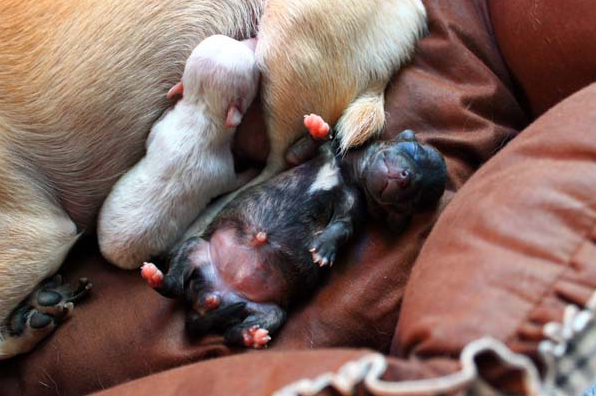
Stumped on how to tell if a puppy is a boy or a girl? The belly and rear end are the points to observe most carefully in determining a puppy’s sex
Even when dogs are fully matured, telling a male from a female dog can be difficult. How many times have you, as a dog owner, passed someone on the street or at the park and heard some variation of, “What a beautiful dog! May I pet her?” And how many times have you gently corrected, “Actually, he’s a boy!” I make that mistake all the time with other people’s dogs, and people make it all the time with mine.
If you’ve recently had or are preparing to welcome a litter of puppies, and people are asking to adopt one, they may have a specific sex of puppy in mind. So, you may be wondering how to tell if a puppy is a boy or a girl. Some people are particular about male or female puppies. Perhaps they’ve had better experiences with one sex of dog over another. Reasons can be difficult to parse, and impossible to understand or predict. If both you and the interested parties are patient, things will become clearer by the time they are ready to be weaned.

Can urination habits help tell if a puppy is a boy or a girl?

Some might huff at the very question, assuming that the stereotypical images of fully grown dog urination habits — squatting for girl dogs and the leg lift of boy dogs — will make the distinction clear enough. In baby puppies, however, one must remember that as puppies’ hindquarters develop and mature, puppies of both sexes squat. The positions that puppies take do not diverge for a while after whelping.
Indeed, male and female puppies may assume identical positions for up to two months. Puppies do not practice independent bowel and bladder evacuation in their first couple of weeks of life. Nor, for the first few weeks, do puppies have sufficient strength and stability in their hindquarters to make urinating activities distinguishable. Male puppies may not fully adopt the wonted leg lift until around their fourth month; for some male puppies, it may not become habitual until they are nearly six months old.

So, how to tell if a puppy is a boy or a girl:

Don’t take a newborn puppy away from his mother for more than a few minutes.
Still stumped on how to tell if a puppy is a boy or a girl? There is, in fact, a way to discern the difference between female and male puppies. Be cautious and patient, though. The relationship between newborn puppies and their mothers can be tenuous. Taking a baby puppy from a mother for more than a few minutes in the first several weeks after whelping can disturb their bonding. A mother dog may become wary of a puppy who spends too much time away from her and the rest of the litter.
Basically, male puppies can be distinguished by two small, raised circular marks on their bellies. People often ask where a dog’s belly button is located. Unlike in humans, the spot where the umbilical cord was attached to a dog disappears, healing over very quickly. It is right below the base of the rib cage. About an inch past that, there will be another small circular spot. This is where the penis will emerge.
Female puppies will have only the belly button mark, with the rest of their tiny little bellies bare. A careful examination of a female puppy’s rear end, from the base of the tail to the start of the lower abdomen, will reveal two openings. The anus, of course, will be just beneath the tail, and the vulva is a small, leaf-shaped structure located almost exactly between the legs.

Always exercise patience and caution when trying to tell if a puppy is a boy or a girl

To put it most simply, the best action for how to tell if a puppy is a boy or a girl is to examine a puppy’s rear end, right beneath the tail. Female newborns will have two points, male puppies only one. It is best to be patient and exercise great caution. In a puppy’s first few weeks, support a baby puppy with a warm towel, turn her over carefully, and only for a couple of minutes at most. Return the puppy to her mother and litter immediately after checking.
Baby puppies begin learning from their mothers the moment they are born. Handling newborn puppies too often before three to four weeks of age risks alienating the puppy from the mother, which can not only cause stress, but also trauma to newborns. For the sake of satisfying curiosity alone, under no circumstances should you poke or prod at newborn puppies as a way to tell if a puppy is a boy or a girl.
-------------------------------------------------------------------
Adrienne Farricelli is a professional CPDT-KA certified dog trainer, and for the last 10 years she has been helping people to eliminate bad behaviors in dogs and train well behaved, obedient, loving pets…by showing them how to bring out the ‘hidden intelligence’ inside their dog. Keep reading to find out more…
Popular Posts